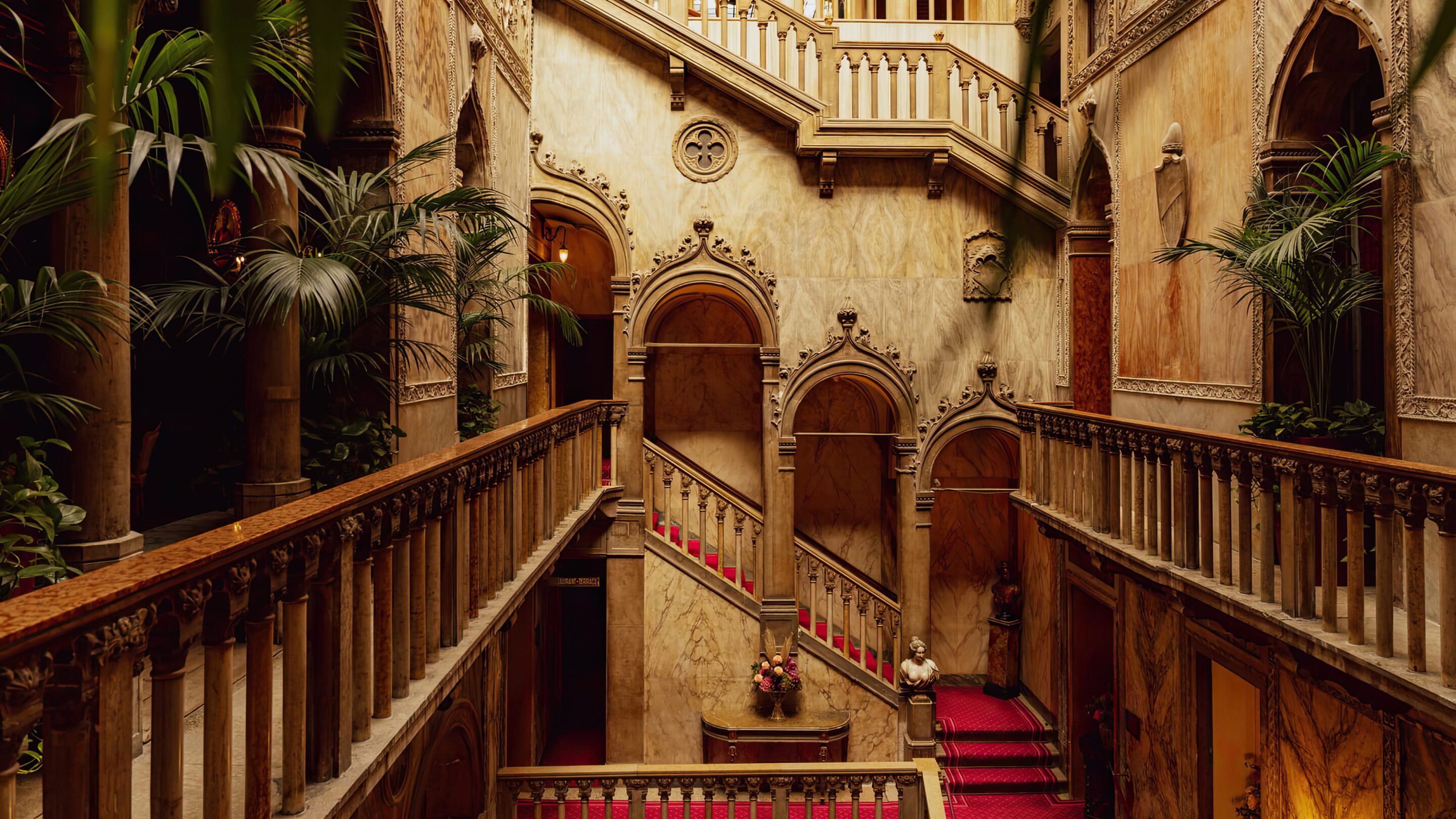
Giving an old building a second life as a grand hotel is a tale nearly as old as the concept itself. In 1822, Giuseppe Dal Niel took a floor of Palazzo Dandolo, a fifteenth-century Gothic palace on the Venetian waterfront, and began letting rooms to travelers. Two centuries later, the Danieli still carries his name and the palazzo still carries the Danieli.
A city’s grandes dames are often a sum of more than their parts – they tend to be a linchpin of its hospitality: the bars the best bartenders compete to work in, the service so often touted as the best received, and the lobbies where the well-heeled end up at eleven o’clock, regardless of whether they have a key for upstairs in their pocket. Every few decades one of them changes hands, and someone has to decide how much of that culture capital and housed history survives the handover.
That decision usually falls to a brand and its designer. It belongs, arguably, to a historian or a curator: someone who can tell an original ceiling from a 1970s imitation, who knows which corridor should stay put because of whose feet have worn it, and which bust in the lobby is the most significant. Between this summer and next spring, three landmark buildings, each with a different version of this story, will open their doors, ready for judgement.
Who’s checking back in?
Venice, Rome and London are the cities to watch this year, each with their own grand dame about to take a new breath of air, which when told together tell a grand hotel’s whole life: one has memories to keep, one has other people’s to live up to, and one is still waiting for first memories to be created.
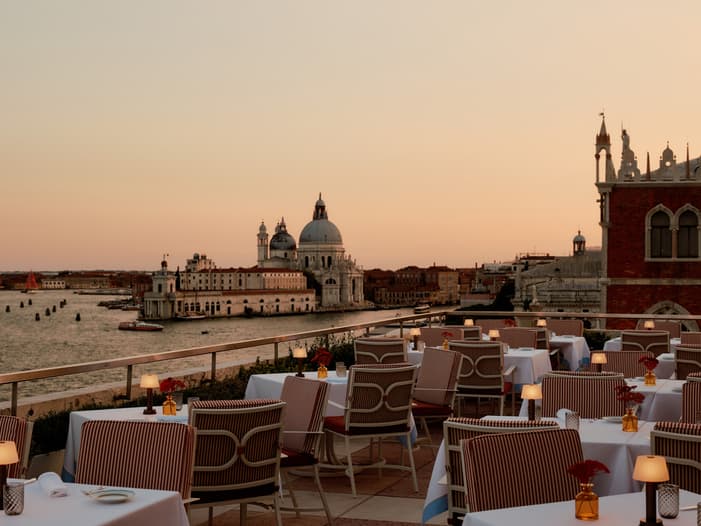
Credit: Courtesy of The Danielli, The Four Seasons
In Venice, The Danieli, reopened on Riva degli Schiavoni on 30th July. In Rome, The Hotel Majestic, which has held court on Via Veneto since 1889, is due back in late 2026 as Baccarat Hotel Rome, and in London, Admiralty Arch, at the top of the Mall is soon to become the capital’s most storied stay address, welcoming overnight guests for the first time in its history in March 2027.
Each comes with a different inheritance: The Danieli has two centuries of regulars and a guest book that, by the hotel’s own account, runs from Charles Dickens to John Ruskin. The Majestic has its street: Via Veneto is where Fellini set La Dolce Vita, the film that gave us the word paparazzi (fitting for a hotel where being spotted is often the point) and Admiralty Arch has a king’s legacy, a century of naval paperwork, a brush with Bond (as all good historic hotels in London seem to) and the opportunity to have your name written in history as its very first guest.
What happened to the Hotel Danieli?
In 2023, The Danieli left Marriott’s Luxury Collection and went through a restoration, reopening as a Four Seasons. Made up of three buildings, Palazzo Danieli Excelsior, which is still under renovation; Palazzo Dandolo, built in 1471 for the noble Dandolo family; and Palazzo Casa Nuova, which once held the Venetian Republic’s treasury.
In 1822, Giuseppe Dal Niel, known as Danieli, rented a floor, living in part of it and letting the rest to travelers. Two years later he bought the building and made it a hotel. Since then it’s played host to a myriad of the creatively charmed; Goethe, Wagner, Charles Dickens, Byron, Peggy Guggenheim, Leonard Bernstein, Benjamin Britten, John Ruskin whilst he was working on The Stones of Venice, Harrison Ford, and Steven Spielberg.
In the winter of 1833, the hotel also staged one of Venice’s best-known literary scandals. Aurore Dudevant, the French novelist better known as George Sand, checked into Room 10 with her lover, the poet Alfred de Musset. Musset soon fell seriously ill with a fever; Sand fell for his doctor, Pietro Pagello. By spring Musset was back in Paris alone, and he later turned the whole affair into a novel, La Confession d’un enfant du siècle.
Pierre-Yves Rochon, the French designer behind the new interiors, has restored the lobby’s gilded ceiling, with its quatrefoil pattern painted against azure, along with the columns, the stonework and the grand staircase that graced a million Instagram stories.
What has changed is mostly in the rooms. Rochon’s palette takes its cue from the spectrum of Venice: celadon, soft blue, terracotta, ochre and powder pink. A palette for all times of the day but will look especially good come five in the evening. The modern amenities – the media walls, automated curtains and air-conditioning – are all there, but you’ll have to look for them.
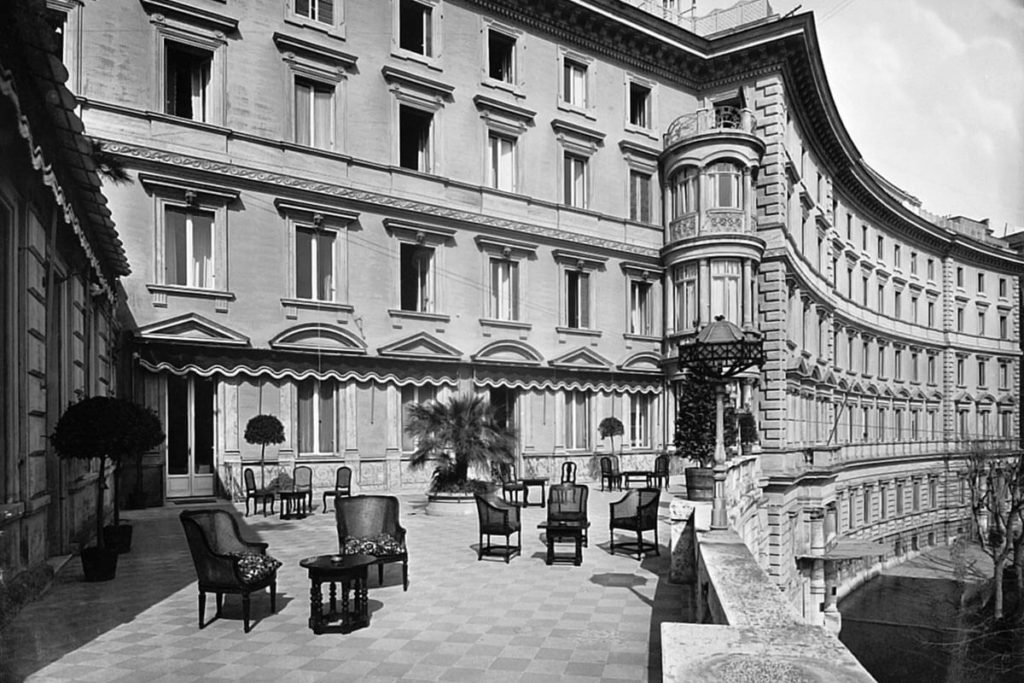
What happens when the Danieli’s designer moves on to Via Veneto?
Rochon has a busy diary, as he’s also designing Baccarat Hotel Rome, alongside IA Interior Architects, so what will happen when we see the same designer, two cities, two very different ideas of glamour.
Originally, the Majestic opened its doors in 1889 on Via Veneto, the street Fellini would later make famous in La Dolce Vita, whilst coining the word paparazzi. For a building whose best years were lit by photographers’ flashbulbs, the new name over the door is apt. Baccarat, founded in 1764, made its name with chandeliers, and its business has always been what light does in a room.
Rome itself has been staging light for centuries: Bernini hid a window behind the pediment in Santa Maria della Vittoria so daylight would fall on Saint Teresa through yellow glass. The painted light in The Calling of Saint Matthew in San Luigi dei Francesi, near Piazza Navona, falls from the right, the same side as the chapel’s real window, so the painting and the room are lit in harmony. Finally, in the Pantheon’s oculus, the only light inside comes through a hole about nine meters across – a very expensive sundial.
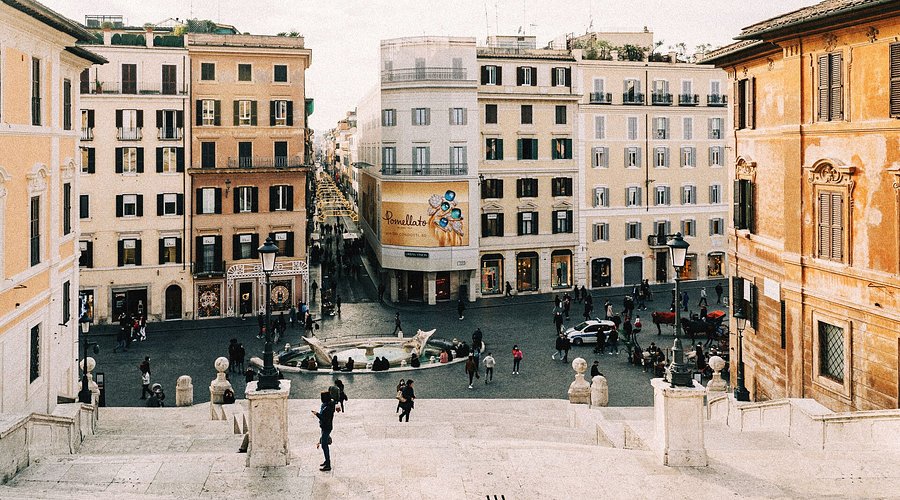
If any of the Majestic’s old guests walk in next year and notice mostly that the place looks brighter, Pierre-Yves Rochon will have worked his magic.
Can a monument learn to be a hotel?
Edward VII commissioned Admiralty Arch in memory of Queen Victoria, and Sir Aston Webb, who also designed the Buckingham Palace facade, completed it in 1912. For most of the century that followed it held Admiralty offices and the official residence of the First Sea Lord. The developers also like to mention that Winston Churchill kept an office there and that Ian Fleming worked in the building. What it has never had, is an overnight guest. It joins a run of London landmarks reopening as hotels, following The OWO in 2023, and whoever checks in first come March will get a footnote in the city’s history.
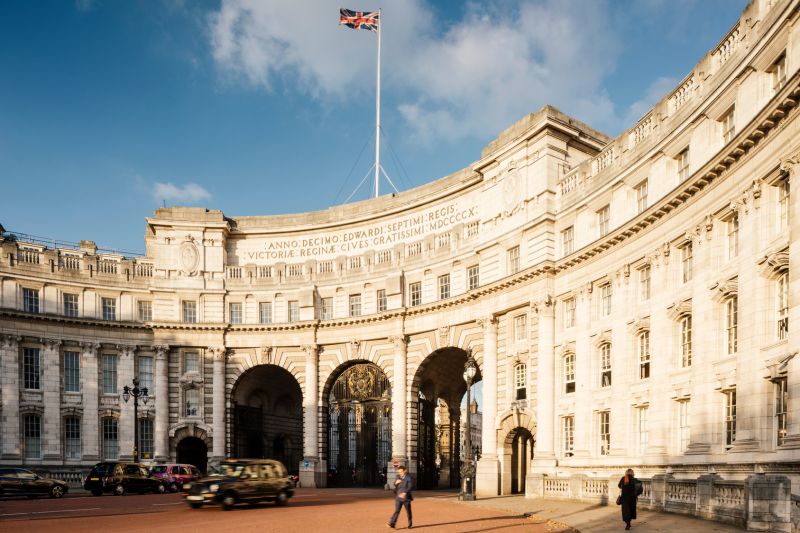
Credit: Courtesy of The Waldorf Astoria
With no guest memories to draw on, the hotel has borrowed the building’s. The 114 rooms, suites and residences include a Nelson Suite and a residence named for HMS Victory. Clare Smyth’s restaurant, Coreus, is built around British coastal seafood, with a bar beside it called Whiskey & Seaweed. Daniel Boulud has the roof, where Café Boulud looks over St James’s Park toward Buckingham Palace. And in the ballroom, a nine-meter Murano chandelier has been restored – so a little of Venice made it to the Mall after all.
Inside the northernmost arch, there is also, or at least was, a small plaster nose. The artist Rick Buckley put it there in 1997, one of 35, as a protest against CCTV – and for fourteen years rumours swirled in London. Was it Wellington’s, or Napoleon’s, or a spare for Nelson? The last time a Victorian landmark with a nose became a grand hotel, at St Pancras, the statement piece did not make it through the works – we’ll wait to see whether Admiralty Arch has been more careful.


